

Weekly Transcript Round-up for 08/07/26
3 murders in last week prompts Council public safety debate; Louijeune raises q's about civilian flaggers; Culpepper gets support for suspensions at Suffolk Co. Sheriff office; Wu talks street safety

While the Council is continuing its light summer schedule - there were just 2 hearings this week, both on dockets offered by the Mayor - there was a lot of policy activity in Boston, and nearby that connect with issues Boston is facing. This activity falls into just 2 buckets, public safety and street safety, with a few specific things to look at:
2 murders spur Council debate over public safety;
Public safety discussion prompts questions about civilian flag-waver program;
Culpepper gets Council support on 2nd try to call for Suffolk County Sheriff staff to be suspended;
Lawyers for Civil Rights gets involved in March 11 video debate with lawsuit;
Wu speaks to WBUR in first public defense of street safety plan; and
Council files 2 street safety dockets, both inspired by Wu’s street safety plan.
Before getting into that, there were 3 other issues that caught BPI’s attention this week:
The Real Deal has a look at the effects of Massachusetts’ broker fee ban one year after it went into effect. Their TL;DR: MA didn’t see the rent spike that NYC did, but that is likely due to other factors. Expect to see more analysis about this issue in the coming weeks as Boston’s traditional September 1 move-in date approaches and state legislators (& Governor Healey) who approved the ban face fall elections.
A federal court ruling dismissing one lawsuit gives North End restaurateurs a new road map for how to sue City Hall over how outdoor dining in the neighborhood was handled. Here is the important part from the Boston Herald’s reporting earlier this week:
While the federal discrimination claims are dead, the plaintiffs could refile a complaint over whether the $7,500 fee they were forced to pay in 2022 violated state law. Kayatta instructed the lower court to dismiss that specific count without prejudice, leaving the door open for a state-level challenge.
This week Newton was ordered by a judge to repay $2M it collected from cannabis dispensaries through a “community impact fee.” This isn’t something that Boston needs to worry about because City Hall stopped collecting those fees from cannabis dispensaries back in 2022 and returned the money they had collected: more than $2.8M.
2 MURDERS THIS WEEK SPUR COUNCIL DEBATE OVER PUBLIC SAFETY
Public safety has been the big issue of the summer as a series of high-profile murders has captured headlines. This week was no exception, with a suspect charged with murder after appears to be a shootout at a Hyde Park restaurant early Monday morning that left 1 person dead and 4 more shot, and on Wednesday a man was shot dead in broad daylight on Blue Hill Ave near the entrance to Franklin Park Zoo.
Those murders drove discussion at this week’s Council meeting, with a number of public safety related dockets on the agenda, and were specifically discussed in 1 docket speech.
Councilor Worrell wants to increase the penalties on people who participate in “street takeovers” and offered a new ordinance - Docket #1540 - to do that this week. Here is what the new legislation would do - he is Speaker 10 & starts at the 1:05:29 mark:
This ordinance tackles the problem with the focus law that levels steep civil fines on offenders, higher fines for repeat offenders, and includes those fines for spectators as well as participants.
Councilor Worrell also had a hearing order - Docket #1545 - about a specific technology that would help Boston Police catch cars participating in street takeovers more easily: noise cameras. Worrell described how it works - he is Speaker 10 & starts at the 1:30:22 mark:
These cameras are limited in the data they collect, so they aren’t privacy concerns. But it has a noise meter and can capture the license plate of cars that trigger that issue. It is portable, so if you know where street takeover might be or where there’s often cars with modified engines, then you can position the technology there.
Councilor Culpepper spoke on a hearing order that he co-sponsored with Councilor Flynn - Docket #1546 - that was focused on communication with the families of homicide victims. Flynn’s remarks focused on that lack of communication with the family of Maude Hinds, who was beaten to death in 1991, when her murderer was paroled earlier this year. Culpepper succinctly described his goal - he is Speaker 14 & starts at the 1:38:33 mark:
The hearing is an opportunity to audit our current notification systems to ensure that families and communities are no longer blindsided by the legal process.
Hinds’ murderer was one of more than 200 people who became eligible for parole after a Supreme Judicial Court decision about “emerging adults” in 2025.
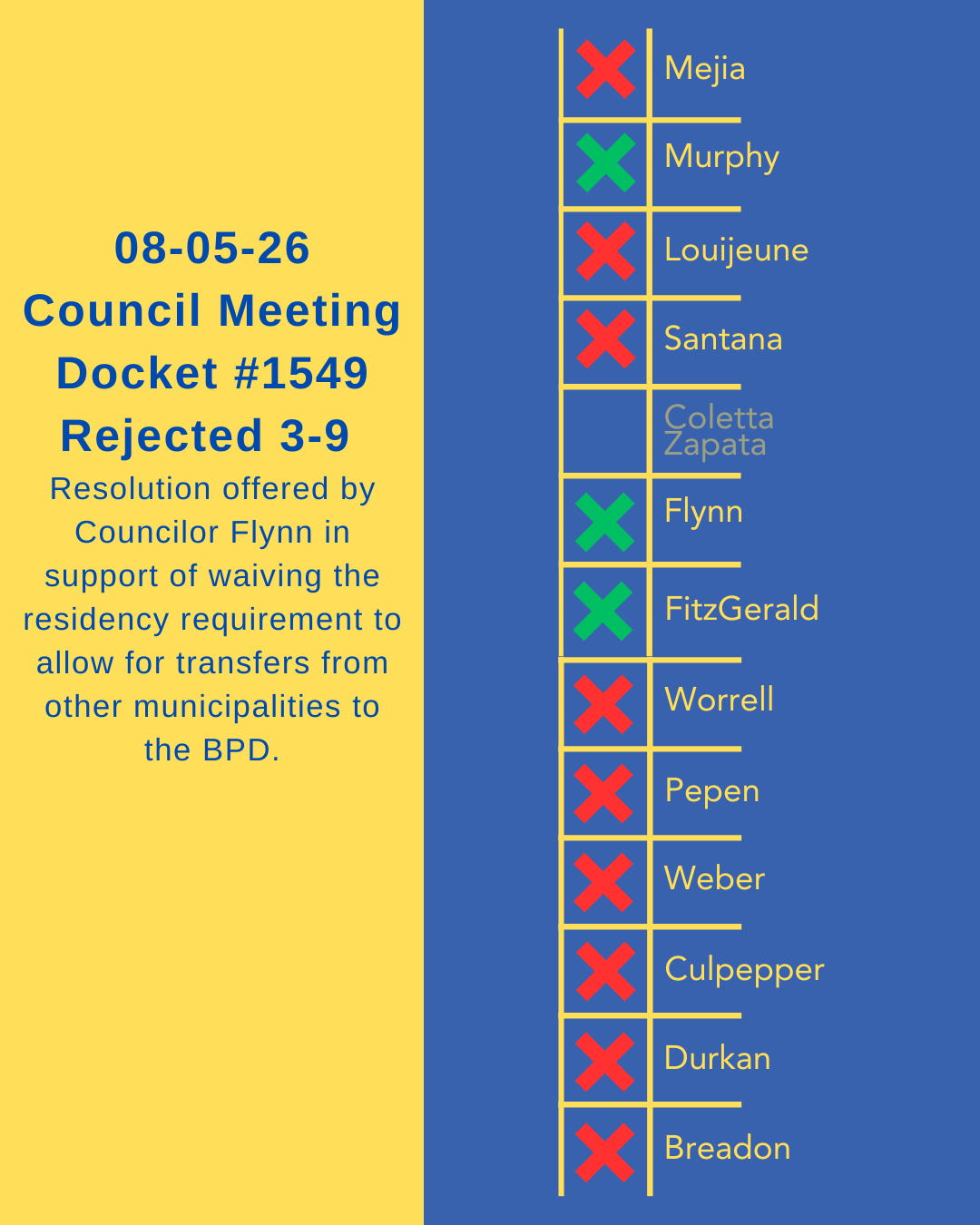
Councilor Flynn explicitly discussed the recent murders in his speech about Docket #1547, a hearing order “to study a waiver from the residency requirement and allow for transfers from other municipalities to the Boston Police Department” - he is Speaker 6 & starts at the 1:41:21 mark. About half way through his speech, he started “Over the weekend, 9 people were shot, 2 deceased,” and then read out all the violence between Friday night and Monday morning. Flynn missed the murder on Blue Hill Ave that happened the morning of the Council meeting.
Councilors defeated the resolution - Docket #1549 - that accompanied that hearing order:
LOUIJEUNE RAISES CIVILIAN FLAGGER PROGRAM IN PUBLIC SAFETY DISCUSSION
3 dockets on Wednesday’s agenda focused on ways to relieve some pressure on a Boston Police Department that it appears there is wide agreement is over-worked and under-manned, and Councilor Louijeune brought up an issue that was intended to help address that pressure: civilian flaggers.
Here is what Louijeune said about the program - she is Speaker 2 & starts at the 1:51:27 mark:
I’m rising because we were on this body. I was on this body when we we talked in great detail about developing a civilian flag up program, something that was really upheld especially by community, by community advocates, and by community leaders to ensure that these details, many of them were going unfulfilled could also be civilianized. And we’ve seen in the process that the whole civilian flagger program has had a really late delayed start, and we haven’t seen it take off in the way that we would want that I personally would want it to, that this council voted and supported. So I would need to know more information about how this would impact what community advocates came in these chambers and really made clear is a desire to develop the civilian flagger program.
The civilian flagger program in Boston has been a years-long saga about which there has been no recent reporting:
In May 2022 the idea was raised by former District 6 Councilor Kendra Lara, who “proposed the creation of a city office that would hire hundreds of residents to flag traffic at Boston’s many construction sites” according to Boston.com;
In December 2023 the new 5 year collective bargaining agreement between the Boston Police Patrolmen Association and City Hall created a path for civilians traffic details at construction sites;
In December 2024 GBH reported that little progress had been made on having civilians work the 40% of construction details that go unfilled;
In March 2025 the Edward Davis Company, led by former BPD Commissioner Ed Davis, got the contract to managed civilian flaggers for City Hall, in a process that some charged was rigged, according to reporting from Yawu Miller.
In April 2025 a company was hired to create an electronic traffic detail system, ending the pen and paper process, and a key part of allowing civilian flaggers, but the Streets Cabinet official quoted in the NBC10 article has since left City Hall.
In July 2025 Councilor Mejia held a hearing on the issue in her Post-Audit Committee, using an omni-bus procurement docket, and the transcript is worth reading because it features City Hall’s defense of the process, and former Boston Police officer & MAMELO President Larry Ellison, laying out his wide-ranging criticism.
In May 2026 at the Boston Police FY27 budget hearing City officials reported that the electronic detail system took longer than anticipated because extensive customization was required, but that testing would start “next week.”
There haven’t been any civilian flagger specific hearing orders offered in 2024, 2025 or 2026. The closest hearing order to this issue that has been offered to the Council this year is Docket #1416, a hearing order “to improve recruitment of civilian crossing guards to serve Boston families” offered by Council Pepen, which he also offered in 2024 and 2025. A hearing has never been held, and none is scheduled in 2026.
CULPEPPER SUCCEEDS ON 2ND RESOLUTION ON SUFFOLK COUNTY SHERIFF
The Council approved on an 11-0-1 vote Docket #1550, a resolution offered by Councilor Culpepper “calling for the Suffolk County Sheriff’s Department to adopt critical-incident administrative leave standards in light of the Medical Examiner’s homicide determination in the death of Shacoby Kenny.”
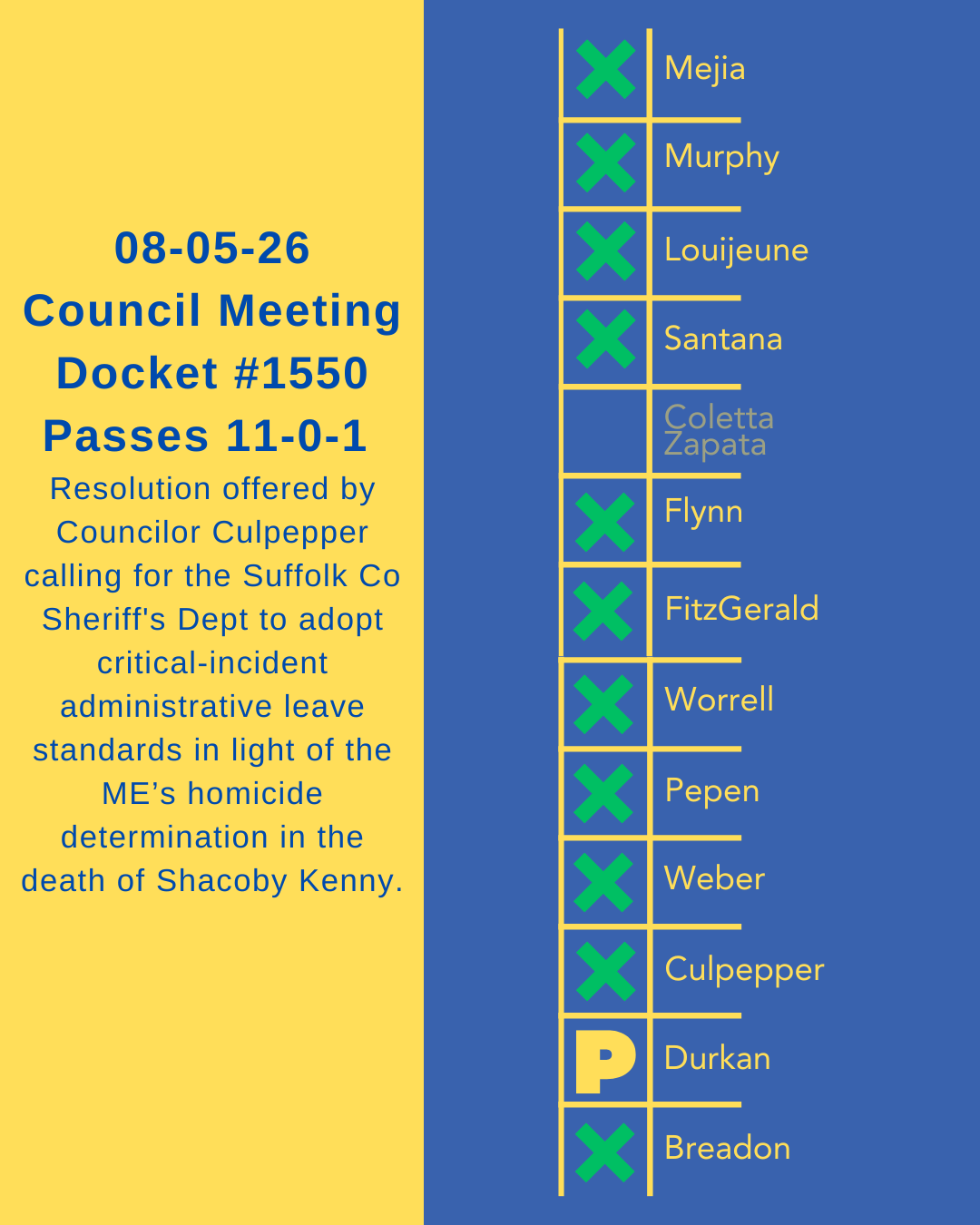
This is a big deal because an earlier version of this resolution, Docket #0872, offered back on 04/29/26, failed on a 6-3-2 vote. That resolution was a little different: it was called “for the temporary suspension of correctional staff involved in the December, 2025 in-custody death of Shacoby Kenny at the Suffolk County House of Correction.”
The Council has no role in the Suffolk County Sheriff’s office, which became a state agency back in 2009. At the time of that homicide finding the Boston Globe’s Adrian Walker provided an update on the investigation into the death:
An investigation is underway, led by the state attorney general’s office in collaboration with the Suffolk district attorney’s office. No criminal charges have been filed, but a robust investigation is active. The guards involved in the altercation that night have been reassigned to unspecified desk duty while the case is under investigation, the sheriff’s office has told the Globe.
LCR GETS INVOLVED IN DEBATE OVER MARCH 11 SHOOTING VIDEO WITH LAWSUIT
This week also a new development in the March 11 police shooting that left a carjacking suspect dead and the police officer who shot him facing manslaughter charges. The powerful legal advocacy organization Lawyers for Civil Rights filed a lawsuit on Tuesday demanding video of the incident be made public.
This comes on the heels of the judge in the case impounding the video until the trail, and is just the latest demand that this video be made public:
Boston City Councilors Brian Worrell and Miniard Culpepper have been demanding this for months, and recently filed legislation to force BPD to make the video public;
The defense attorney for the police officer indicted for the shooting has demanded the video be made public, saying it will exonerate his client; and
The family of the victim, speaking through their attorney, also demanded that video be made public.
LCR’s entry into this case is something to watch because the organization plays a big role in public policy in Boston and Massachusetts. LCR’s lawsuit threat was a major factor in Boston’s changes to its exam school entry policy and they’ve been involved in a number of police misconduct lawsuits, including filing a lawsuit last year on behalf of Eddy Chrispin after he was demoted for being appointed to the POST Commission, and another earlier this year on behalf of another deputy superintendent who says he was demoted after uncovering widespread paid detail fraud.
WU SPEAKS PUBLICLY ABOUT STREET SAFETY FOR FIRST TIME SINCE 7/24/26 LETTER ON WBUR
On Tuesday morning WBUR ran a story about an interview Mayor Michelle Wu gave to Morning Edition host Tiziana Dearing the day before.
In the interview Dearing focused on what appears to be quite a wide gap between Wu’s rhetoric and action when it comes to prioritizing street safety and mollifying other interests.
Wu refused to acknowledge this gap, and the first question and response really captured the Mayor’s unwillingness to admit that she has moved very significantly on street safety since taking office:
DEARING: In 2016, you wrote an op-ed in the Boston Globe that basically said we’ve just got to do this: bike lanes, reduced parking. Business owners may be upset, but we just have to do it. And then later last year, you told GBH it quote it matters when small businesses say they can’t keep their doors open because of all their parking for employees is gone. We didn’t really worry about that too much. We just wanted to move as quickly as possible. Looking back, has your philosophy on that balance changed in your time as mayor of Boston?
WU: I wouldn’t say the balance has changed. I would say I have a deeper and now much more grounded in reality understanding of what balance actually means.
The refusal to say that she had moved significantly extended to the street safety plan she released in the 7/24/26 letter. While the letter has been presented as a new plan by the press, Wu effectively said during the interview that the plan presented in the letter was not new, and the letter was simply describing actions the City was already taking. Here is that line:
I wanted to better communicate some of the things that had already been happening in the background that that have been taking time and have been taking too much time, but that are really important for us to be able to go faster in the long run.
This interview appears to be the first public interview that Wu had given since she released her 7/24/26 letter laying out the City’s street safety plan. Since the Council hasn’t held any street safety hearings since Louisa Gag’s death on July 9th, this also represented the first public defense of Wu’s street safety plan.
Listen to the whole story on WBUR’s website, and watch a clip of the interview from WBUR’s YouTube Shorts:
COUNCIL FILES 2 STREET SAFETY DOCKETS, BOTH INSPIRED BY WU’S STREET SAFETY PLAN
This week’s regular Council meeting also saw 2 more more street safety hearing orders, both directly inspired by and referring to Mayor Wu’s 7/24/26 letter.
The first of these 2 hearing orders is Docket #1542 from Councilor Weber, and is “to review safety of the operation of heavy commercial vehicles and potential measures to protect pedestrians and cyclists in the City of Boston.” The written docket shouts out Wu’s 7/24/26 letter, and so Weber also shouted out the Mayor in his speech - he is Speaker 4 & starts at the 1:15:24 mark:
In the a public letter issued by, uh, the mayor last Friday, uh, she wrote that there is work to be done to advance more comprehensive truck safety legislation, um, and that includes work at the state level. Here in Boston, we we have a truck side guard ordinance. It’s been on the book since 2014.
The second of these hearing orders was Docket #1543 from Councilor Durka, and is “on traffic enforcement of blocked bike lanes and crosswalks.” Unlike Weber, Durkan’s docket and speech didn’t directly quote or reference Wu’s 7/24/26 letter.
However, this issue was in the letter: it got its own section, titled “Targeted, Effective Enforcement.” That section is a clear jumping off point for Durkan’s docket, beginning:
Even the most well-designed streets become unsafe when vehicles are double-parked or blocking bike lanes, crosswalks, or sidewalks. The City is ramping up targeted enforcement efforts at high-risk locations and working to improve our technology and response time.
The letter goes on to describe a number of new enforcement tactics, including a new app, putting parking enforcement officers on bikes, and using cameras for automated enforcement, which is legal for school buses. Wu also talked about crosswalk and bike lane enforcement in her interview with WBUR this week.
Durkan’s docket got covered by the Boston Herald this week, and the headline focused on the last 2 lines of her speech introducing the docket - she is Speaker 12 & starts at the 1:18:25 mark:
We really need to make sure that pedestrians are king in District 8, and they’re king in our city, and we need to make sure that they have all the protections. Um, getting drivers, um, from stopping in crosswalks is the bare minimum.
These 2 dockets join the list of street safety dockets that have already been offered, and like those, no hearings on any of them are currently scheduled.
Boston Policy Institute, Inc is working to improve the public conversation - help us by following BPI on YouTube, TikTok, Facebook, Instagram, Threads, Twitter, and LinkedIn.
Two comments - First, ten boston homicides past 35 days unlike any stretch since summer 2020.
And regarding Durkan's commentary on safety, the pedestrian first approach she touts while advocating for cyclists can be later utilized as a push back to bike folks when they want a protected bike lane on Charles St or other more pedestrian oriented corridors.