

Transcript Round-Up for 01/09/26
5 takeaways from Wu’s inaugural speech; 4 questions from Council Prez vote; PLUS Skerritt Vice Chair for new look BSC

This week was packed with important news and policy action, much of which will be felt in the weeks and months ahead. In this WTR BPI has two deep dives:
5 Takeaways from Mayor Wu’s 2nd Inaugural Speech - BPI provided analysis of Mayor Wu’s 2nd inaugural speech to a number of media outlets - read more in WBUR, Axios, & Herald - but keep reading for a more detailed breakdown, including sorting through the stats, adding context to the free bus claim, looking for details on housing rhetoric, a lost opportunity on Boston’s fiscal crisis, and examining recently teased new initiatives that weren’t included in the speech.
4 Questions after a shocking Boston City Council President election - why did 3 Councilors withdrew support from Coletta-Zapata, exactly what makes Breadon a “compromise candidate”, who will chair the Council’s handful of important committees, and what did Breadon learn from her 2022 re-districting flub all remain unanswered.
Before getting into those two, there was also news from the Boston School Committee over the last week:
Less than 48 hours before her inauguration Mayor Wu announced her 3 appointments to the Boston School Committee - re-appointing Stephen Alkins, and appointing two new members Lydia Torres and Franklin Perrault;
Mayor Wu ignored the Boston Globe Editorial Board’s recommendation back in November to re-appoint Brandon Cardet-Hernandez, a former public school principal in NYC and education policy leader who got glowing coverage in this Globe column back in 2023 and who Wu herself appointed for his single term on the BSC back in 2022;
Rachel Skerritt replaced long-time member Michael O’Neill as BSC’s Vice Chair, a position O’Neill resigned from in order to lead the Boston Private Industry Council.
Here is how Marcela Garcia introduced Cardet-Hernandez in her 2023 column:
Sometimes it takes an outsider to see through calcified groupthink. Why does the Boston Public Schools own its fleet of buses? How many open positions does the district currently have? How many of them are teaching jobs? What is the breakdown of these vacancies by school?]
BSC meetings will be significantly less informative without Cardet-Hernandez, and his loss will be felt as BPS faces the challenges presented by declining enrollment, budget cuts, and the prospect of how to integrate the $700M bill for a new Madison Park High School into the capital budget.
5 TAKEAWAYS FROM MAYOR WU’S 2ND INAUGURAL
After reading and watching the Mayor’s speech, the headline was that it featured a lot of high-flying rhetoric, but very few concrete policy proposals.
There were 5 big takeaways from it:
1. SORTING THROUGH THE STATS
There are 4 numbers and a fraction that stood out in the Mayor’s speech: 4,200; 2,000; 5,000; 200; and half.
We prioritized housing like never before, building 4,200 affordable homes with another 2,000 under construction - p. 2.
The veracity of Mayor Wu’s affordable housing stats have been a consistent issue for City Hall. Comparing the the numbers in the Mayor’s speech to claims the Mayor made back in January and then February 2025 shows why. Here is a number offered by the Mayor in January 2025, which makes it appear that less than 150 affordable units were either built or started construction over the last year:
Just a few days after that tweet, City Hall published a significantly lower number: 5,455 income-restricted units completed or in construction or more than 500 units less than the 6,098 in the Mayor’s Bluesky post.
How City Hall creates these counts has never been thoroughly explained.
We expanded Boston pre-K to serve 5,000 families and helped 200 new childcare providers open their doors to our littlest learners - p .3.
These are two important stats - 5,000 families, 200 childcare providers - in Boston’s now years-long struggle over exactly what “universal pre-K” means. Unfortunately, putting these numbers in context with policy actions taken over the last several years doesn’t make the City’s progress toward this goal much clearer.
To understand the struggle, we need to rewind to see what Mayor Wu’s predecessor Marty Walsh achieved on the issue. According to the Boston Globe in February 2021: “The number of city-funded slots has increased from 2,439 to 3,425 over Walsh’s tenure,” or about 53% of the City’s 6,400 4-year-olds.
4 years later in a December 2025 article the Globe reported that the number of : “under her [Wu’s] watch, the city has expanded pre-K programs at BPS, which now serve 53 percent of 4-year-olds in Boston, and 23 percent of 3-year-olds.” There is that 53% number again, meaning that between 2021 and 2025 Boston did not add any pre-K seats in BPS.
So how could Boston still serve more families? Because of the second part of the Mayor’s line: “200 new childcare providers.”
Early in her first term Mayor Wu invested $20M in early childhood education - this is the investment that created the “200 new childcare providers” from the speech. In July 2022 the Boston Globe reported: “the new funding will add just under 1,000 seats for both 3- and 4-year-olds at child care facilities outside the Boston Public Schools . . . The city aims to offer high-quality, free preschool to all 4-year-olds.” In that same article reporters write: “City officials say many of those children don’t want or need slots in city-led preschool.”
Those 1,000 seats aren’t in BPS, so wouldn’t be counted in the Globe’s statistics in the 2025 article.
Cut our retail vacancy rate nearly in half compared to two years ago - p. 3.
Retail has consistently been a bright spot for Boston, which makes the inclusion of this claim in the Mayor’s speech unusual. Unlike office or lab space, retail space in Boston is not experiencing the same historically high vacancy rate.
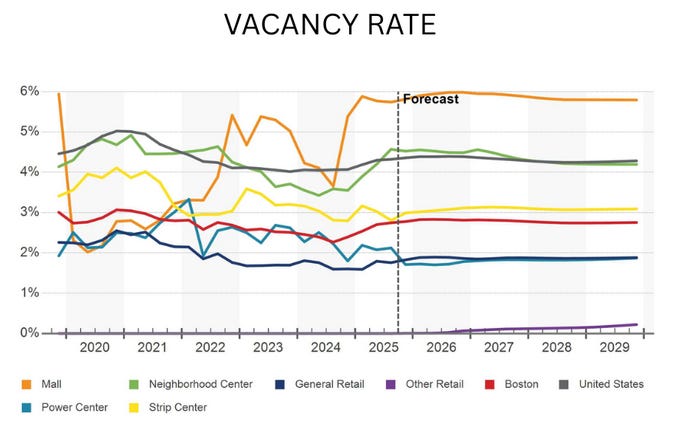
On the contrary, according to experts Boston has consistently remained one of the tightest markets for retail space in the country throughout the post-COVID era.
2. ADDING CONTEXT TO THE FREE BUS CLAIM
Made three bus routes fare-free - p. 3.
While it is true that Mayor Wu used City dollars to make 3 bus routes - the 28, 29, and 23 - free for her entire first term, that funding is running out on February 28, 2026.
In her speech on Monday, Mayor Wu did not say whether Boston would continue to pay for these lines to be free. That is an important question as policy priorities like free buses run into the budget cuts announced back in December.
Not expanding on free buses also missed a chance to call back to her 1st inaugural speech, where a Boston student’s use of the free 28 bus was a major focus.
3. NO DETAIL ON HOUSING RHETORIC
Mayor Wu’s focus on housing featured heavily in the speech and attracted press coverage, but this is the closest she got to a policy proposal:
Over the next four years, we will continue inventing new ways to use public planning, public finance, and public land to create the homes our residents need, because we know that housing is a public good. We are the city that created whole new neighborhoods out of swampland and invented the triple-decker to tackle the housing crises of our past.
The lack of specificity is particularly unusual because there are a number of housing policy reforms being pursued inside City Hall - from changes to the City’s planning bureaucracy, to Article 80 reform, to the various zoning reform processes - that with a public push from the Mayor could come into effect.
The Mayor’s decision to ignore those reforms is highlighted by her “inventing new ways” language. Right now, Boston does not even seem capable of copying other communities good housing policies, let alone inventing new ones.
At hearings in December city planners told the Council that Boston had no plans to pursue triple-decker legalization, ADU legalization, or parking minimum abolition. That mean Boston will continue to lag Cambridge and Somerville (and peer cities across the country) on abolishing parking minimums and reforming zoning to allow triple-deckers city-wide, and lag the entire Commonwealth on ADUs, since 350 communities - every town & city in Massachusetts except Boston - now allow ADUs by-right in single family home zoned district.
4. A LOST OPPORTUNITY TO PREPARE BOSTON FOR THE FISCAL CRISIS
Mayor Wu did not say the words “tax” or “budget” in her speech on Monday.
That was a big change from just a month ago, when Mayor Wu’s letter to the Boston City Council in early December had a number of worrying stats: 13% hike in homeowners property tax bill, 2% cut to City Departments in the upcoming FY27 budget, and a 6% drop in total assessed value of commercial property. Mayor Wu used those stats to demand that Beacon Hill take action on her long-dormant tax shift proposal, which also was missing from her speech.
Boston CFO Ashley Groffenberger and BPS CFO David Bloom added worrying stats of their own in testimony before the Council and School Committee in December:
Groffenberger said that the historically low level of new growth seen in FY26 was expected to continue into FY27 and FY 28, meaning the leans years at half way into Mayor Wu’s 2nd term;
Bloom said that BPS expected to see 300 to 400 BPS staff “mostly classroom teachers and paraprofessionals” eliminated in the upcoming FY27 budget.
Not only was none of this bad news discussed in the Mayor’s speech, she promised better constituent services and improved outcomes in BPS, two goals that usually are accomplished through more spending.
5. RECENTLY TEASED NEW INITIATIVES THAT WEREN’T IN THE SPEECH
In the last month Mayor Wu and her administration announced that in 2026 her administration would launch two new efforts aimed at downtown Boston and the City’s budget, neither of these efforts were discussed in the inaugural speech:
QUINCY MARKET: On December 10, 2026 Jon Chesto reported:
Mayor Michelle Wu has asked her planning chief Kairos Shen to assemble a task force of urban planning experts early next year, to come up with a new vision for the city-owned marketplace.
In that same column Chesto explains that this City Hall Task Force was parallel to an existing private-sector effort launched by attorney R.J. Lyman.
REVENUE PANEL: According to the Boston Globe, in a press briefing in early Decmeber Mayor Wu told reporters:
She would create a “time-limited” task force in 2026 to explore ways to bring in additional cash. The task force will include both community and business stakeholders who would “really dig deep into revenue options for the city of Boston,” Wu said.
Now Boston will need to wait for more details in the coming days and weeks. Budget deadlines are fast approaching where more details must be shared with the public:
February 4, 2026, when Boston Public Schools is required to unveil their FY27 budget, which BPS CFO David Bloom said “you should expect to see a reduction in FTE” and later said “I would anticipate it’s going to be at least 3 to 400 positions, primarily teachers and paraprofessionals in schools”; and
April 8, 2026, when Mayor Wu is required by law to send her FY27 budget to the Boston City Council.
3 QUESTIONS AFTER BOSTON CITY COUNCIL PRESIDENT SHOCKER
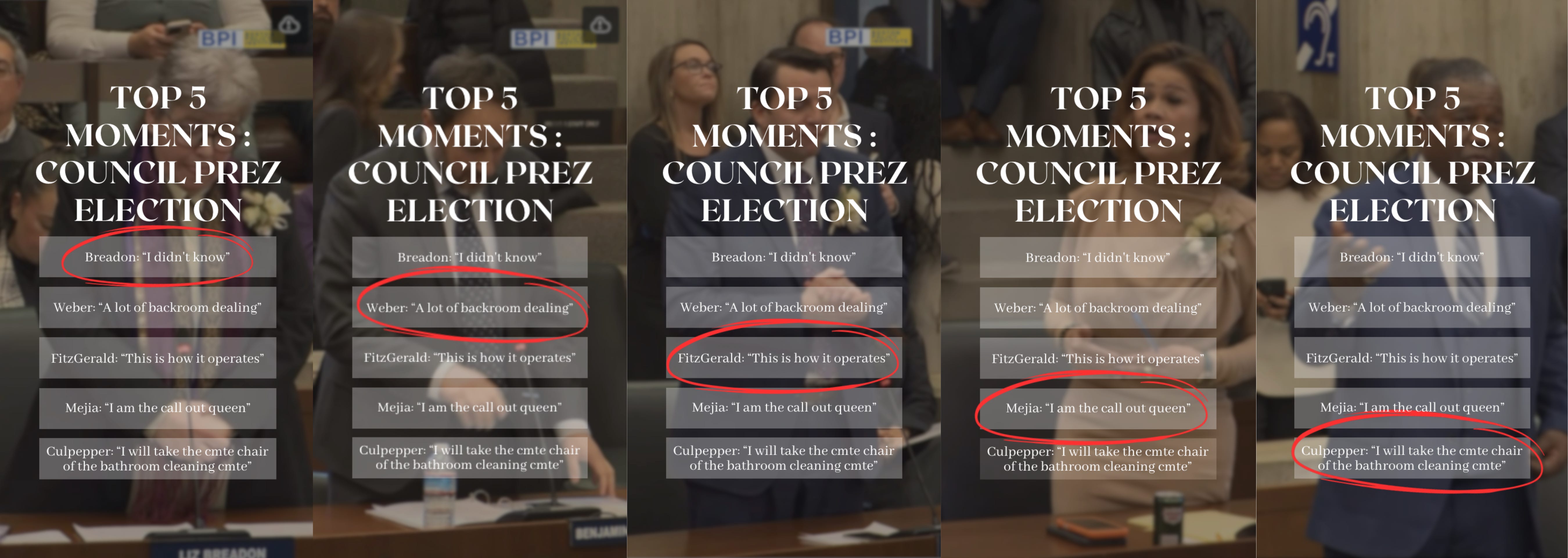
The outcome of Monday’s vote for Boston City Council President grabbed an enormous amount of attention - in the Boston Globe alone this contest generated an editorial and 3 columns from Joan Vennochi, Adrian Walker, and Kevin Cullen. A number of other outlets and reporters provided excellent coverage of the story as it developed, and the post-vote fallout.
There are 4 big questions that haven’t been answered yet.
Why did 3 Councilors withdrew their support for Coletta Zapata? It has been widely reported that sometime on Sunday 3 Councilors - District 3’s John FitzGerald, District 5’s Enrique Pepen, and District 9’s Liz Breadon - told Gabriella Coletta Zapata that they would no longer support her for Council President. There has been no reporting on what drove that decision and no Councilor discussed it in their remarks at the Council’s hour long debate on Monday.
Why is Breadon calling herself a “compromise candidate”? “Compromise” implies that Breadon attracted the support of Councilors who had planned to support District 4 Councilor Brian Worrell for President, but Adrian Walker reports in his column that was not the case:
In the end, the same coalition Coletta Zapata thought she had put together — minus FitzGerald — backed Breadon, the third front-runner in barely 24 hours. She won by a 7-6 vote over Worrell Monday.
Which Councilors will Chair which committees? If Breadon is truly a “compromise candidate” then this will be seen here. On Tuesday District 2 Councilor Ed Flynn, who voted for Worrell on Monday, publicly asked Breadon that to appoint him chair of the Public Safety Committee, which was chaired by Councilor-at-Large Henry Santana (& prospective Council VP for Coletta Zapata) last year. Public Safety is one of the Council’s most important committees, and the other important committees to watch are: Ways & Means, Government Operations, Education, and Planning. For “compromise candidate” to be more than rhetoric, at least a few of those committees must be led by Councilors who voted against Breadon for Council President.
What did Breadon learn from re-districting flub? Before being elected Council President Monday, Breadon’s last high-profile leadership role on the Council was as Chair of the Redistricting Committee in the 2022-2023 term, a role she took after the previous chair Ricardo Arroyo was ousted. As Redistricting Chair Breadon oversaw a process that produced a map in 2022 which was thrown out by a federal judge in 2023. Reviewing the coverage and court docs from that trail, Breadon is now the last Councilor whose public statements and staff communications was cited as a reason to throw the map out. The other 3 Councilors whose public statements were cited by plantiffs in their successful effort to throw the map out were Ricardo Arroyo and Kendra Lara, who were both defeated in the preliminary election in 2023, and Tania Fernandes Anderson resigned from the Council in 2025 after pleading guilty on federal corruption charges.
Boston Policy Institute, Inc is working to improve the public conversation - help us by following BPI on YouTube, TikTok, Facebook, Instagram, Threads, Twitter, and LinkedIn.
Thanks for all of your insights!